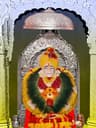
The appearance of the Maharaj
On Magh Vadya Saptami in February 1878, a young ascetic was first seen outside a house in Shegaon, absorbed in a state beyond hunger and comfort. No one knew where he came from; devotees came to know him as Shri Gajanan Maharaj. This day is celebrated every year as Prakat Din, one of Shegaon's greatest festivals.
The Maharaj lived in Shegaon for over three decades as a digambara saint — indifferent to body and possessions, constantly absorbed in the divine, and endlessly compassionate to those who came to him.
गण गण गणात बोते
The Maharaj continually chanted the mantra 'Gan Gan Ganat Bote' — and devotees chant it to this day, in the mandir queues and in homes far from Shegaon. It is understood as pointing to the oneness of the individual soul with the divine that pervades everything.
Samadhi and the Sansthan
Shri Gajanan Maharaj took samadhi on Rishi Panchami day, 8 September 1910, having told devotees he would remain present at Shegaon. His samadhi mandir rose at that spot, and the Shri Gajanan Maharaj Sansthan — the public trust formed to serve it — has become known across India for its disciplined, devotee-first management of the mandir, Bhakta Niwas accommodation, mahaprasad and Anand Sagar.
His life and leelas are recorded in the Shri Gajanan Vijay Granth composed by Sant Dasganu Maharaj, read devotionally in countless Marathi households — many devotees complete a parayan of the granth at Shegaon itself.
The Pandharpur of Vidarbha
Because of the scale of devotion it draws — lakhs of pilgrims through the year, swelling on Prakat Din, Ram Navami and Samadhi Din — Shegaon is often called the Pandharpur of Vidarbha. Palkhi processions connect Shegaon to Pandharpur's great Wari tradition, and for many families a Shegaon yatra is a yearly vow kept across generations.
Need a room for these dates?